sudokUI › Sudoku techniques › 2-String Kite
2-String Kite in sudoku
Turbot Fish shape · 4-candidate X-Chain · how it fits
A row and a column each hold a conjugate pair for X, four different cells; one end of each shares a box, and the others do not see each other.
Why it works
The two ends in the shared box cannot both be X, so at least one of the other two ends must be X. X is eliminated from every cell outside the pattern that sees both of those ends.
How to spot it
Find a box where a row conjugate pair and a column conjugate pair each have one end, then check the cell seeing both far ends.
Worked example
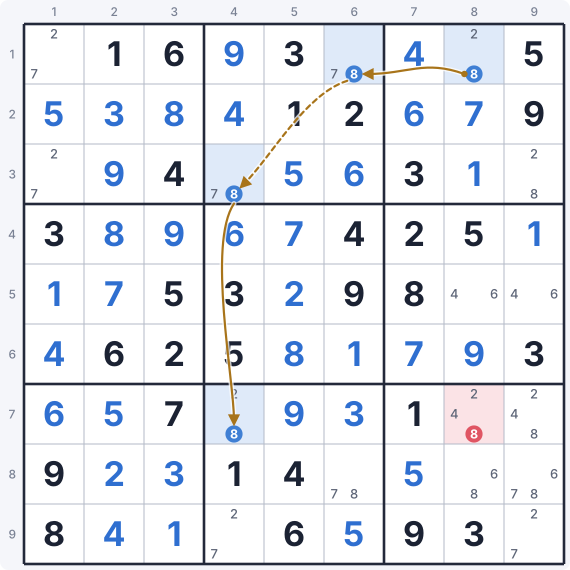
2-String Kite on 8: r1c6 and r1c8 are the only places for 8 in row 1, as are r3c4 and r7c4 in column 4, and r1c6 sees r3c4. If r1c8 is not 8, r1c6 is, so r3c4 is not, so r7c4 is: one of r1c8 and r7c4 is 8, and 8 is removed from every cell that sees both. So 8 is removed from r7c8.
Practise it on a real puzzle. sudokUI generates a puzzle that needs 2-String Kite and takes you straight to the position where it applies. Hints draw the pattern on the board and explain the step.
In a puzzle's rating
Each time the solver needs 2-String Kite, the puzzle's difficulty rating grows by 150. Its class is Hard. It is needed in 1 in 13 puzzles that sudokUI generates. How the rating works.