sudokUI › Sudoku techniques › How they fit together
How sudoku techniques fit together
sudokUI's catalogue names 80 techniques. Underneath them are three ideas and one promise the puzzle makes. Learn the ideas and every name becomes a new shape of something you already know. Each idea is explained twice here: once properly, and once the way you would explain it to a 12-year-old.
The one rule
Two facts in one rule
Exactly once is two promises. At least once: if a digit has only two places left in a unit, one of them is it. At most once: two candidates for the same digit in cells that see each other, by sharing a row, a column or a box, cannot both be true. A cell makes the same two promises: it holds at least one digit, and at most one.
When exactly two options are left, two places for a digit in a unit or two candidates in a cell, solvers call the first kind a strong link; the second kind is a weak link. Nearly every technique on this site, from the Hidden Single to the Forcing Net, combines these two facts until a candidate is ruled out or a digit is forced. Only the uniqueness techniques add a fact of their own, further down.
There are two ways to ask the question. Ask a cell which digits it can still hold, or ask a digit where it can still go in a unit. The first way finds the naked patterns, the second the hidden ones, and good solvers switch between them without thinking.
Locked sets: things that must fit
Singles: one thing, one place
A Naked Single is a cell with one candidate left: one place, one digit. A Hidden Single is a digit with one place left in a unit. They are the smallest locked sets there are, seen from the two directions: ask the cell, or ask the digit. A Full House, the last empty cell of a unit, is both at once.
Subsets: two, three or four at a time
Scale the single up. If two cells of a unit can hold only the same two digits, those digits are used up there, so no other cell of the unit can have them: a Naked Pair. If two digits can go only in the same two cells of a unit, those cells are taken, so they can hold nothing else: a Hidden Pair. Triples and quads work the same way.
Naked and hidden are two descriptions of one fact. In a unit with seven empty cells, a naked triple leaves the other four cells for the other four digits, and those four cells are a hidden quad. That is also why nobody needs a naked or hidden five: its other side is always four or smaller.

Where a box crosses a line
A box and a row share three cells. If all of a digit's candidates in the box lie in that overlap, the box will put the digit there, so the rest of the row cannot have it: Pointing. Swap the roles and it is Claiming: a row whose candidates for a digit all lie inside one box clears that digit from the rest of the box. Columns work the same way.
It is the smallest locked set between two units: one unit forced to place its digit inside another. A Locked Pair is a naked pair sitting in the overlap, so it clears both units at once.
Fish: one digit, many rows
Now follow one digit across the whole grid. If in two rows the digit can go only in the same two columns, the two rows will use those two columns up, one each, so nothing else in those columns can be that digit: an X-Wing. Three rows in three columns is a Swordfish, four in four a Jellyfish. In a Swordfish a row may have two spots or three; what matters is that all of them fall in the same three columns.
Shrink an X-Wing to one row and one column and you get a Hidden Single: a row where the digit fits in one column only. So a Hidden Single really is a 1-fish, an X-Wing a 2-fish and a Swordfish a 3-fish, and rows and columns can swap roles. Pointing and Claiming are 1-fish too, with a box on one side. A fish bigger than four is never needed, because a fish in five rows always comes with a smaller one in the columns, just as a naked five comes with a hidden subset of four or fewer.
The same trick, seen sideways
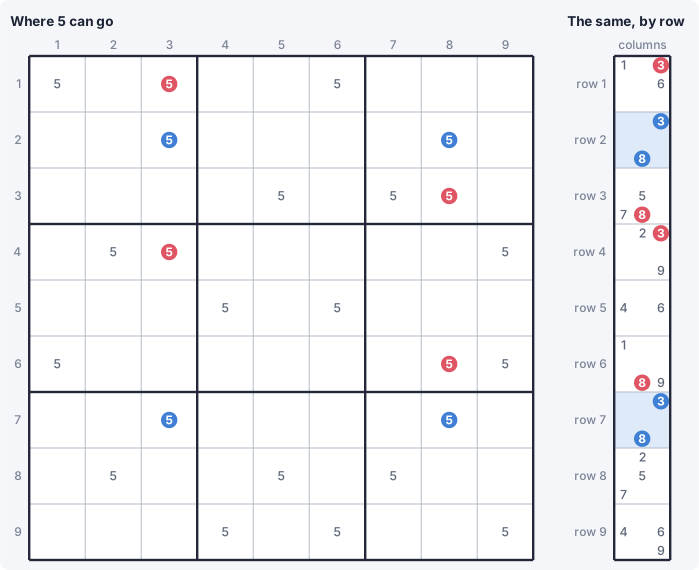
Picture the puzzle as a cube whose three directions are rows, columns and digits. The usual grid shows rows against columns. Turn the cube and you see rows against digits instead. For one digit, write down for each row the columns where it can still go. Each row becomes a little cell whose candidates are column numbers, and the nine rows behave like a unit: every column number belongs to exactly one of them.
Now an X-Wing is two of those cells holding the same two column numbers: a Naked Pair. A Swordfish is a Naked Triple and a Jellyfish a Naked Quad. Turned another way, the cube shows a naked pair as a hidden pair. Every fish of rows and columns without a fin is a subset in costume, and so is every subset in a row or column; a subset inside a box, or a fish that uses a box, has no such twin, because a box is not one of the cube's directions.
Fins, and fish with boxes
A finned fish is a fish with a few extra candidates, the fin, crowded into one box. Either the fish is real or the fin holds the digit, so a cell in the fish's columns, outside its rows, that sees every fin cell loses the digit either way. A Sashimi fish is a finned fish whose finned row, without its fin, would have only one spot left. Franken fish let boxes stand in for rows or columns.
Either this or that is how chains think, and chains come later. A finned fish is the first place on this page where a locked set and a chain meet.
Almost locked: one too many
Almost locked sets
An almost locked set is N cells in one unit holding N+1 digits between them. Take any one of those digits away and the cells lock onto the rest. The smallest is a single bivalue cell: one cell, two candidates.
That makes every almost locked set a switch. If one of its digits turns out to be impossible, the set becomes locked and places all the others.
Bent subsets: the wings
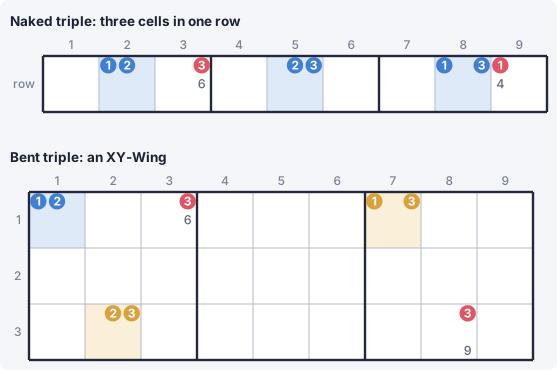
Put a naked triple in one row and it is locked. Bend it round a corner, so the three cells sit in two units, and it nearly still works. That is an XY-Wing or an XYZ-Wing: three cells, three digits, bent. Four cells and four digits make a WXYZ-Wing, a bent quad, and five make a VWXYZ-Wing, a bent quint.
Why it works: in a bent subset, every digit but one has its candidates in cells that all see each other, so it can be used at most once. Only one digit, Z, might repeat, because its cells do not all see each other. Without Z, the cells would need as many different digits as there are cells, from one digit fewer. That is impossible, so Z is in the pattern, and any cell that sees every Z in it loses Z.
XY-Wing and XYZ-Wing differ only in whether the middle cell, the pivot, also holds Z. If it does, the removed cells must see the pivot as well.
ALS-XZ: the parent of every bent wing
Take two almost locked sets with no cell in common, both holding the digits X and Z. If every X in the first set sees every X in the second, at most one set can have X, so at least one set goes without it. A set without X locks onto its other digits, Z among them. So at least one of the two sets places Z, and Z can go from any cell that sees all the Zs in both sets.
Each bent wing in the catalogue is this rule with one set made of a single bivalue cell: an XY-Wing is a bivalue cell plus a two-cell set, a WXYZ-Wing a bivalue cell plus a three-cell set. That is why some guides, sudoku.coach among them, now call the bigger wings simply ALS-XZ, and why sudokUI finds a five-cell wing of that shape under ALS-XZ.
The idea grows from there. ALS-XY-Wing is an XY-Wing whose three cells have grown into sets, Death Blossom gives each candidate of one cell a set of its own, and Sue de Coq shares out the crowded cells where a box crosses a line between one set in the rest of the line and one in the rest of the box.
Not every wing is bent
The W-Wing shares the name but not the idea. It is two identical bivalue cells joined by a strong link on one of their digits, which makes it a short chain rather than a bigger XYZ-Wing. The W does not mean one more letter.
Chains: if not this, then that
Strong and weak links
A strong link joins two candidates of which at least one is true: a digit with two spots left in a unit, or a cell with two candidates. A weak link joins two of which at most one is true: two candidates for one digit that see each other, or two candidates in one cell. A chain alternates them, starting and ending with a strong link. If this end is false, the next is true, so the one after is false, and so on.
When a chain starts and ends on the same digit, one of its two ends is true, so any cell that sees both ends loses that digit. When a chain closes into a loop whose links alternate all the way round, every weak link in it can remove candidates of its own.
One-digit chains: kites, skyscrapers and turbots
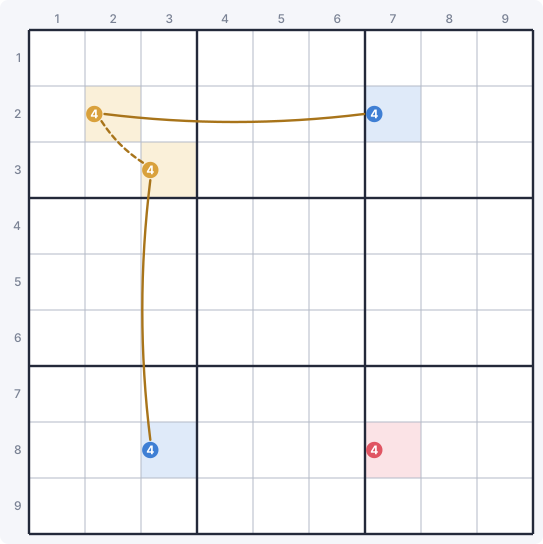
A chain that follows one digit is an X-Chain. Its shortest useful form is two strong links joined by a weak one, four candidates in all, and its shapes have their own names: a Skyscraper when the two strong links run parallel, a 2-String Kite when one runs along a row and the other down a column and they meet in a box, and a Turbot Fish for the other shapes.
An X-Wing is that chain closed into a loop, and an Empty Rectangle splits the candidates in one box into a row group and a column group, at least one of which holds the digit. Longer chains on one digit are X-Chains too, and the loops are X-Cycles.
Colouring: two worlds
Start from one candidate of a digit and follow its strong links outwards, colouring alternately in two colours. Everything you reach is one cluster, and in it one colour is entirely true and the other entirely false; you just do not know which yet. If one colour would put the digit twice in a unit, that colour is false. If a cell sees both colours, it loses the digit whichever colour wins. A separate cluster needs colours of its own.
Simple Colors pictures one cluster of strong links at once, so it finds every X-Chain built only from that cluster's links. Multi Colors joins two clusters, and 3D Medusa colours across all the digits at once.
Chains of pairs
A bivalue cell is a strong link inside a cell: if it is not one digit, it is the other. Hop from a bivalue cell to another bivalue cell that sees it, through a digit they share, and leave each cell by its other digit: that is an XY-Chain. Its three-cell version is the XY-Wing again, which is how one pattern can be a wing, a bent subset, a pair of almost locked sets and a chain at the same time. A Remote Pair is an XY-Chain whose cells all hold the same two digits.
One chain to hold them all
An Alternating Inference Chain allows every kind of link at once: one digit along a unit, two digits in a cell, a group of candidates in a box, even a whole almost locked set. Most named patterns are short AICs or loops: the X-Wing, the Skyscraper, the XY-Wing, the W-Wing and ALS-XZ among them. A Nice Loop is the same thing written as a loop.
Forcing chains are the last step before guessing. Assume a candidate and follow every consequence, then do the same for the alternatives. If all the branches agree on something, it is true, and if one branch ends in a contradiction, its starting assumption was false. They are powerful, but there is no shape to spot, which is why sudokUI keeps them for the hardest puzzles.
The promise: one solution
Deadly patterns
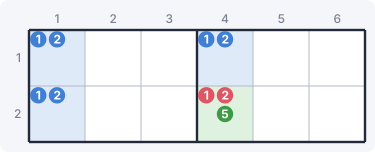
Four cells in two rows, two columns and two boxes that could only hold the same two digits would be a trap: the two digits could swap places and both versions would fit. That is two solutions, so a puzzle with one solution never ends up like that. If three corners of the rectangle hold only 1 and 2 and the fourth holds 1, 2 and 5, the fourth must be 5. That is a Unique Rectangle. BUG+1 uses the same promise on a trap that covers the whole grid, and the Avoidable Rectangles on rectangles whose corners include digits you placed yourself.
These techniques are only valid when the puzzle really has one solution. sudokUI only accepts puzzles that do, so here they are always safe.
Underneath it all
Truths and links
Allan Barker's set logic describes nearly all of it at once. A truth is a group of candidates of which exactly one is true: the candidates of a cell, or one digit's places in a unit. A link is a weak link stretched to a whole group: of all its candidates, at most one is true. If N truths that share no candidate are covered by N links, the truths use up every link, so any other candidate in those links is false. That single rule is every locked set and every fish without a fin.
Allow one link more than there are truths and you get chains, finned fish and wings, where a candidate falls only if it sits in two of the links at once. Most technique names are short ways of saying where the truths and the links are.
Why the names are a mess
X-Wing came first
By June 2005 a forum regular already counted X-Wing and Swordfish among the few names most players agreed on, and nobody in that thread could say who had coined them. The two-row fish was known and named before players saw that three or four rows work too, so the family was named around it: Swordfish, Jellyfish, then Squirmbag, Whale and Leviathan for sizes nobody needs. That is why the X-Wing is a fish and not a wing.
Squirmbag was unpopular, and by late 2005 players were suggesting Starfish instead. The X most likely stands for the diagonal shape of the four corners. The Star Wars fighter and the Fairey Swordfish biplane are popular stories without a known source, so treat them as folklore.
Letters that count digits
In the wings the letters nearly count digits. The XYZ-Wing, WXYZ-Wing and VWXYZ-Wing use three, four and five digits, so as bent subsets they are a triple, a quad and a quint. The XY-Wing uses three digits too, a bent triple like the XYZ-Wing, but its letters name only the two in its pivot. Y-Wing is not a different or a newer technique. It began in 2005 as a forum shorthand for XY-Wing, and both names are still in use. Bigger wings, VWXYZ and up, have names too, but they are found as ALS-XZ, the rule they come from, and some guides now use only that name.
The W-Wing breaks the pattern: it is a chain, and its W does not count anything.
Names that teach
On 26 December 2005 a forum user called Havard posted the Skyscraper and the 2-String Kite, while admitting that both were Turbot Fish. Another regular asked why an existing technique needed new names, and listed ten names already in use for the same family. Havard answered that the names help people remember the pattern. The shape names won, because they teach better.
Sue de Coq is usually said to be named after the forum handle of the player who first posted it, as Two-Sector Disjoint Subsets. Bob Hanson named 3D Medusa himself: a three-dimensional view made him think of Medusa and her hair.
How solving changed
The techniques arrived as separate tricks with separate names, and the theory that joins them came later. That order is the reason the catalogue reads like a zoo.
- Mid-2005
- X-Wing and Swordfish are already standard names, and fish of up to five rows have names on a programmers forum.
- Autumn 2005
- Names are still unsettled: one player calls every fish of three or more rows a Swordfish, another says he found the X-Wing on his own and called it a rectangle. Sue de Coq is posted as Two-Sector Disjoint Subsets.
- November 2005
- The BUG principle: if every unsolved cell has two candidates and every candidate appears twice in each unit, the grid cannot have exactly one solution.
- December 2005
- The Skyscraper and the 2-String Kite get their names. 3D Medusa, Bob Hanson's colouring across all digits, is already one of the names in use.
- January 2006
- A forum regular sums up what players have been noticing: the XY-Wing is just a short forcing chain, and the X-Wing and the Turbot Fish are X-Cycles.
- Around 2006 and 2007
- A forum guide to fish covers boxes (Franken and Mutant fish) and Kraken fish, and the Empty Rectangle is in use.
- Since then
- Unifying ideas take over: almost locked sets show that the bent wings are one rule, set logic shows that fish, subsets and chains are one counting idea, and the Sudoku Explainer rating becomes the common yardstick of difficulty.
Getting fast
Hard to see is not hard to understand
Sudoku Explainer rates the Naked Pair 3.0, the X-Wing 3.2 and the Hidden Pair 3.4, though in a row or column all three are one pattern seen from different sides. It rates the Turbot Fish 6.6, yet other guides, HoDoKu among them, teach it early. Ratings measure how hard a pattern is to spot, not how deep it is. Once you know the idea, a new pattern stops being a thing to memorise and becomes a familiar thing in a new place.
So scan by idea, not by name. Count first: singles. Then look for locks: pairs and triples in a unit, a digit confined to a box and line overlap, one digit lining up in the same columns across several rows. Then look for almost locks: bivalue cells are the smallest almost locked set and the start of every wing and XY-Chain. Then follow links: a digit with two spots in a unit is a strong link waiting to be chained.
The How to solve tab shows how the best solvers order this in practice, and practice mode puts most techniques, one at a time, in front of you as the very next move.