sudokUI › Sudoku techniques › BUG+1
BUG+1 in sudoku
All unsolved cells are bivalue cells except one with three candidates, and every candidate in a unit appears exactly twice, except X, three times in each of that cell's units.
Why it works
Without X in that cell, the grid would be all bivalue cells with every candidate twice per unit, so any solution would have a twin using each cell's other candidate. Assuming the puzzle has exactly one solution, X is placed in that cell.
How to spot it
When all unsolved cells but one are bivalue cells, find the cell with three candidates: the one appearing three times in its row is X.
Worked example
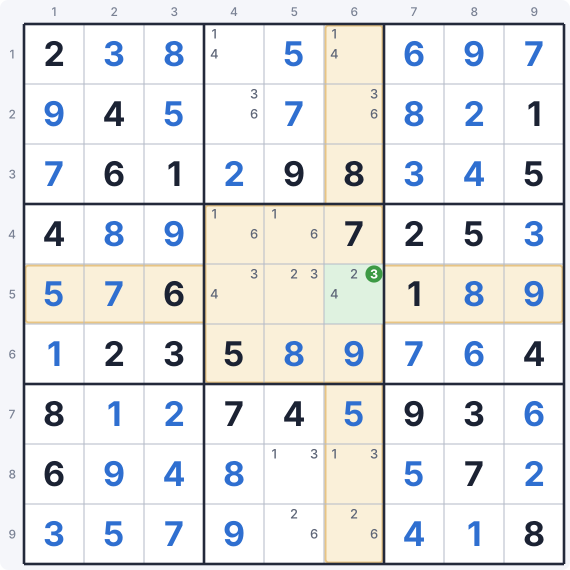
BUG+1: removing 3 from r5c6 would leave a bivalue grid with two solutions, so r5c6 must be 3.
Practise it on a real puzzle. sudokUI generates a puzzle that needs BUG+1 and takes you straight to the position where it applies. Hints draw the pattern on the board and explain the step.
In a puzzle's rating
Each time the solver needs BUG+1, the puzzle's difficulty rating grows by 100. Its class is Hard. It is needed in 1 in 59 puzzles that sudokUI generates. How the rating works.
More uniqueness
Unique Rectangle Type 1 · Unique Rectangle Type 2 · Unique Rectangle Type 3 · Unique Rectangle Type 4 · Unique Rectangle Type 5 · Unique Rectangle Type 6 · Hidden Rectangle · Avoidable Rectangle Type 1 · Avoidable Rectangle Type 2 · Extended Rectangle