sudokUI › Sudoku techniques › Sashimi Swordfish
Sashimi Swordfish in sudoku
Three rows (or columns) have candidate X only in three shared columns (or rows) plus fins, extra cells in one box, and a finned row has only one non-fin candidate.
Why it works
If no fin is true, all three columns get their X from the three rows; if one is, its box holds no other X. Cells of those columns in the fin box, outside the three rows, lose X, or likewise with rows and columns swapped.
How to spot it
Look for a Swordfish where one row has a single non-fin candidate, plus other candidates for X in one box crossed by another Swordfish column.
Worked example
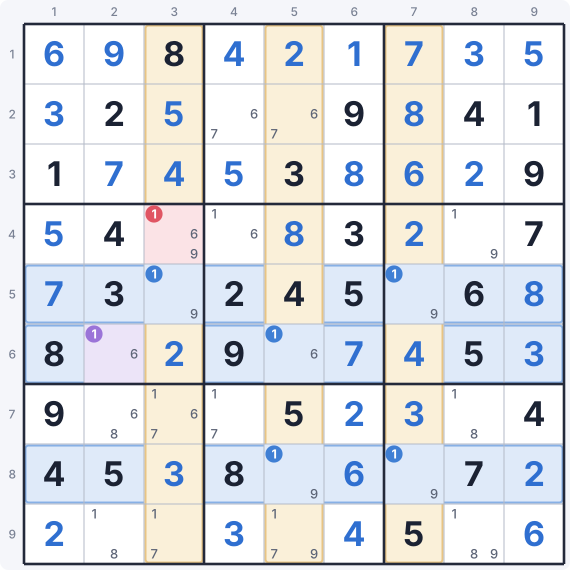
Sashimi Swordfish on 1: in rows 5, 6, 8, 1 sits in columns 3, 5, 7 (r5c3, r5c7, r6c5, r8c5, r8c7) except for the fin r6c2. Either the fin is false and the fish holds, or the fin is true; a 1 that sees every fin and lies in the cover columns outside the base is false both ways. So 1 is removed from r4c3.
Practise it on a real puzzle. sudokUI generates a puzzle that needs Sashimi Swordfish and takes you straight to the position where it applies. Hints draw the pattern on the board and explain the step.
In a puzzle's rating
Each time the solver needs Sashimi Swordfish, the puzzle's difficulty rating grows by 240. Its class is Unfair. It is needed in 1 in 330 puzzles that sudokUI generates. How the rating works.
More finned fish
Finned X-Wing · Sashimi X-Wing · Finned Swordfish · Finned Jellyfish · Sashimi Jellyfish