sudokUI › Sudoku techniques › W-Wing
W-Wing in sudoku
a short AIC, not bent · how it fits
Two bivalue cells, both with candidates X and Z, do not see each other; a conjugate pair for X has one end seeing the first, the other seeing the second.
Why it works
One end of the conjugate pair must be X, so the bivalue cell it sees loses X and becomes Z. At least one bivalue cell is therefore Z, so Z is eliminated from every cell outside the pattern that sees both bivalue cells.
How to spot it
Find two identical bivalue cells that do not see each other, then look for a conjugate pair on one of their digits bridging them.
Worked example
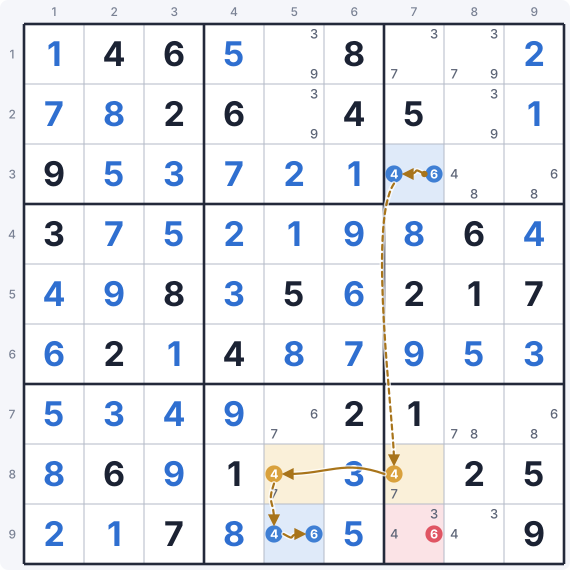
W-Wing: r3c7 and r9c5 both hold 46; the strong link on 4 (r8c5–r8c7) forces one of them to be 6, removing 6 from cells seeing both. So 6 is removed from r9c7.
Practise it on a real puzzle. sudokUI generates a puzzle that needs W-Wing and takes you straight to the position where it applies. Hints draw the pattern on the board and explain the step.
In a puzzle's rating
Each time the solver needs W-Wing, the puzzle's difficulty rating grows by 150. Its class is Hard. It is needed in 1 in 16 puzzles that sudokUI generates. How the rating works.