sudokUI › Sudoku techniques › WXYZ-Wing
WXYZ-Wing in sudoku
bent quad · ALS-XZ · how it fits
Three cells in one unit hold exactly the candidates W, X, Y and Z between them; a fourth cell, bivalue with X and Z, sees each of those holding X.
Why it works
If the bivalue cell is X, the three cells lose X and must share W, Y and Z, so one of them is Z; otherwise the bivalue cell is Z. Z is eliminated from every other cell that sees all pattern cells holding candidate Z.
How to spot it
Look for three cells in a unit holding four candidates between them, then for a fourth, bivalue cell nearby made of two of those digits.
Worked example
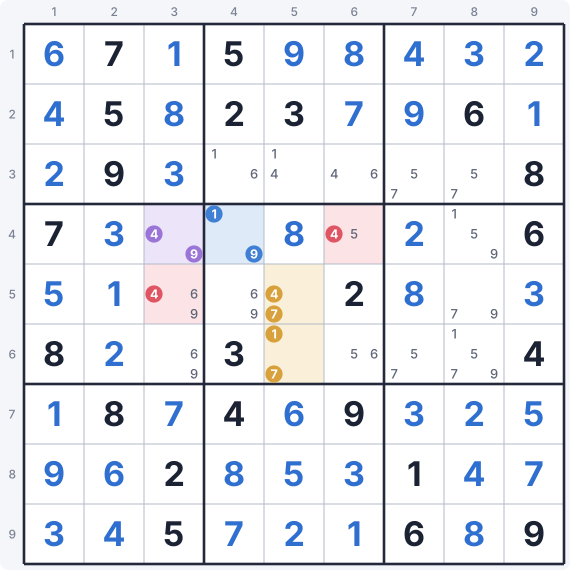
WXYZ-Wing: bivalue cell r4c3 (49) and the three cells r4c4, r5c5 and r6c5 in box 5, which hold 1479 between them. The 9 in r4c3 sees every 9 in the three cells. Either r4c3 is 4, or it is 9 and the three cells in box 5 must be 1, 4 and 7. At least one of the four cells is therefore 4, so 4 is removed from every other cell that sees all the 4s among them. So 4 is removed from r4c6, r5c3.
Practise it on a real puzzle. sudokUI generates a puzzle that needs WXYZ-Wing and takes you straight to the position where it applies. Hints draw the pattern on the board and explain the step.
In a puzzle's rating
Each time the solver needs WXYZ-Wing, the puzzle's difficulty rating grows by 200. Its class is Hard. It is needed in 1 in 12 puzzles that sudokUI generates. How the rating works.