sudokUI › Sudoku techniques › ALS-XY-Chain
ALS-XY-Chain in sudoku
XY-Chain made of sets · how it fits
Four almost locked sets form a chain: neighbours share a joining digit whose cells all see each other, each middle set's joins differ, and both ends hold another digit Z.
Why it works
If one end lacks Z it locks and places its joining digit, removing that digit from the next set, and so on until the far end must place Z. So Z is removed from any cell outside the chain seeing every Z in both ends.
How to spot it
Build the chain from small sets such as bivalue cells, link by link, and after three links check whether both ends share a candidate.
Worked example
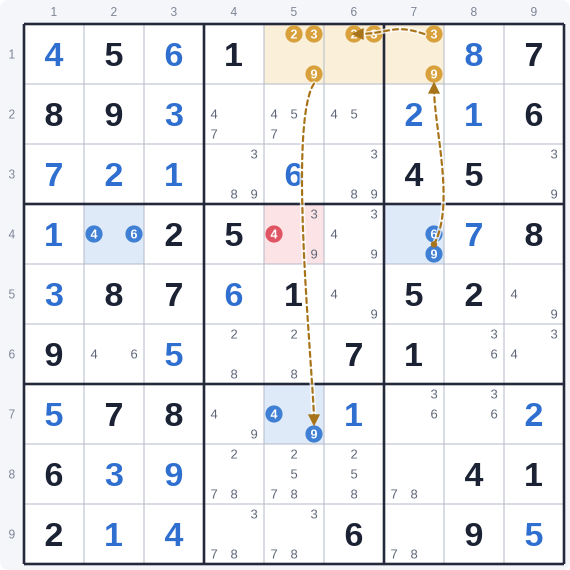
ALS-XY-Chain: if set A (r7c1, r7c2, r7c4, r7c8) holds no 1, it holds a 6; then set B (r5c2, r5c3, r5c4, r5c8) holds no 6 and holds a 1, C (r5c9) no 1 and a 6, and D (r1c9, r2c9, r7c9, r8c9) no 6 and a 1. A or D holds a 1, so no cell that sees every 1 of both can be 1. Here, 1 is removed from r7c7.
Practise it on a real puzzle. sudokUI generates a puzzle that needs ALS-XY-Chain and takes you straight to the position where it applies. Hints draw the pattern on the board and explain the step.
In a puzzle's HoDoKu rating
Each time the solver needs ALS-XY-Chain, the puzzle's HoDoKu rating grows by 340. Its class is Unfair. It is needed in 1 in 98 puzzles that sudokUI generates. How the HoDoKu rating works.