sudokUI › Sudoku techniques › Nishio Forcing Chain
Nishio Forcing Chain in sudoku
One candidate is assumed true, and the singles it forces end in a contradiction: an empty cell without candidates, or a unit with no place for a digit it lacks.
Why it works
Every naked or hidden single in the run is a certain consequence of the assumption, so the contradiction proves the assumption false. The assumed candidate is eliminated, and nothing else from the run is kept.
How to spot it
Test a candidate X whose cell sees several bivalue cells containing X, since assuming it true turns each of them into a naked single.
Worked example
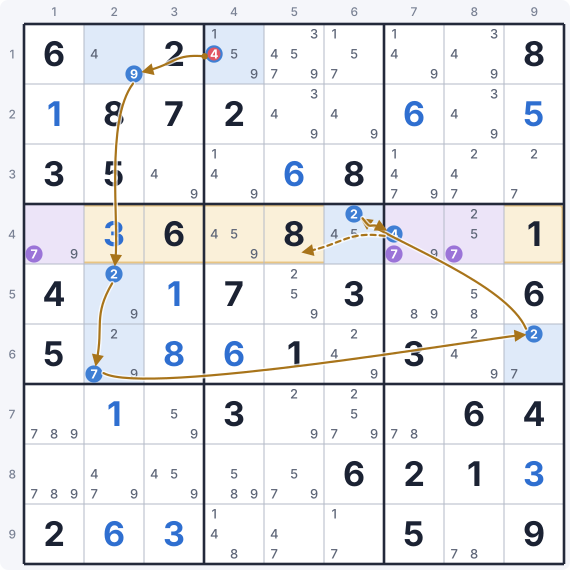
Nishio: assuming r1c4 = 4 and following the forced singles leads to a contradiction, so 4 is impossible there.
The solver uses this on the hardest puzzles. It has no pattern to spot, so it is not offered in practice.
In a puzzle's rating
Each time the solver needs Nishio Forcing Chain, the puzzle's difficulty rating grows by 500. Its class is Extreme. It is needed in 1 in 13,000 puzzles that sudokUI generates. How the rating works.
More last resort
Exocet · Double Exocet · Pattern Overlay · Forcing Chain · Digit Forcing Chain · Cell Forcing Chain · Unit Forcing Chain · Forcing Net · Brute Force