sudokUI › Sudoku techniques › XY-Chain
XY-Chain in sudoku
XY-Wing is the 3-cell case · how it fits
A chain of bivalue cells, each seeing the next and joined to it by a shared candidate that changes at every cell, leaving an unused candidate Z at both ends.
Why it works
If one end is not Z, it takes its joining candidate, forcing each following cell to its other candidate until the far end becomes Z. At least one end is Z, so Z is removed from every cell outside the chain seeing both ends.
How to spot it
Start at a bivalue cell, assume it is not Z, follow the forced digits through bivalue cells, and stop when one becomes Z.
Worked example
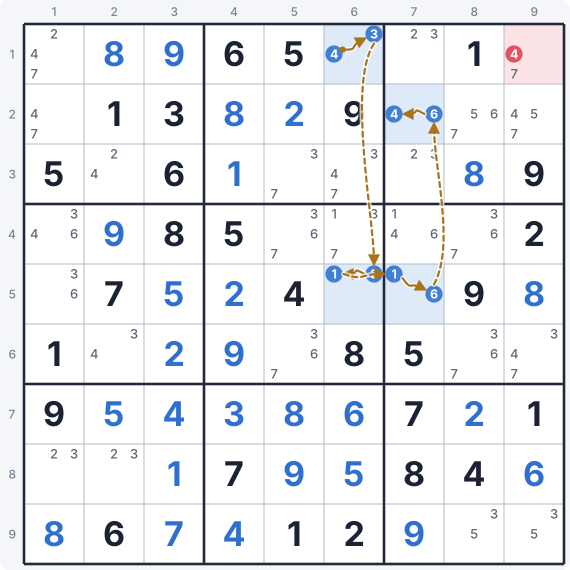
XY-Chain: r1c6 → r5c6 → r5c7 → r2c7; whichever way the chain resolves, one end is 4, so 4 is removed from cells seeing both ends. So 4 is removed from r1c9.
Practise it on a real puzzle. sudokUI generates a puzzle that needs XY-Chain and takes you straight to the position where it applies. Hints draw the pattern on the board and explain the step.
In a puzzle's rating
Each time the solver needs XY-Chain, the puzzle's difficulty rating grows by 260. Its class is Unfair. It is needed in 1 in 30 puzzles that sudokUI generates. How the rating works.
More chains and loops
Remote Pair · Chute Remote Pair · X-Chain · X-Cycles (loops) · Grouped X-Cycles · Twinned XY-Chains · Nice Loop · Grouped Nice Loop · Alternating Inference Chain · AIC with Groups · AIC with ALSs